Best Strategies for Time Management in Law Exams: What I Wish I Knew Earlier

IF I KNEW THEN
Episode Five: I Wish I Had Taken Time Management More Seriously
Knowing the answer is not always enough.
Sometimes, you know the law ,you understand the question. You know the cases and principles and yet, somehow, you still don’t get to write everything you know.
Why?
Time.
Time management was something I gradually learnt to take seriously, and honestly, I wish I had started much earlier. In 100 level, it wasn’t really a problem at least, not in the way it became later.
I remember being concerned about finishing my examination, but the pressure wasn’t quite the same. I didn’t yet understand how much time would matter when several law courses were demanding my attention at the same time.
Then I got to 200 level and suddenly, time management became a completely different ball game.
It wasn’t just about having enough time to read.There was the reading,understanding,comprehending ,trying to make sense of cases.
After doing all of that, you still had to sit in an examination hall and actually deliver everything you had learnt.
Those are two very different things.
You can spend hours studying a course and feel like you understand it completely.
Then the examination starts. You see the question, you know what they are asking and somehow, you start writing…
And writing… Just because you’re trying to make sure the lecturer sees everything you know. You’re wondering, Is this enough? “Should I explain this more”?
Maybe I should add this case too.
What if this is the point the lecturer is looking for?
Before you know it, you’ve spent so much time on one question that you suddenly look at the clock and realise you have other questions waiting for you.
That was one of the things I struggled with. Sometimes, it wasn’t that I didn’t put in the effort.
I did.
Sometimes, I simply wasted time.I wanted to make sure I had written enough to satisfy the question, but I wasn’t always sure what “enough” actually looked like and because I wasn’t sure, I just kept writing.More explanations, things I had read and sometimes, I still didn’t properly answer the question.
Then the examination ends. You submit your script and later, when the result comes out, you start asking yourself: Did I really put in enough effort?
Did I actually know this course?
Why didn’t my result reflect all the time I spent studying?
It took me a while to understand that sometimes the problem wasn’t what I knew. It was what I did with the time I had.
I had to start asking different questions. I spoke with people.
I paid attention to what worked for other students and began trying different approaches for myself.
I realised that I needed to stop thinking about examinations only as a test of how much I knew. They were also a test of how well I could use limited time to communicate what I knew.
So I became more intentional. I started putting myself in examination situations.
I would ask myself: If this were an actual examination, what would I write?
What is the question really asking me?
What does the examiner actually need to see?And most importantly:When do I move on?
That last question became very important to me because I eventually learnt that answering an examination question does not mean writing everything you know about the topic.
Your lecturer is not asking you to reproduce the textbook. Your job is to answer the question.
and sometimes, answering the question properly means knowing what not to write.
Then someone gave me advice that stayed with me. My fellowship hosted a programme, and during one of the sessions, I asked a question about managing time during examinations.
The speaker gave an example that I have carried with me ever since.
He said ” If you have a three-hour examination, that is 180 minutes. If you are expected to answer four questions, dividing 180 minutes by four gives you 45 minutes per question”.
Instead of planning to use the full 45 minutes, the advice was to aim for 40 minutes per question that way, you save five minutes from each question.
Five minutes × four questions gives you 20 minutes at the end.
Twenty minutes to go back.You are able to check your answers, add something important you may have missed and, most importantly, avoid getting to the end of the examination and realising that you have one question left with no time to answer it.
It sounded so simple but it changed the way I looked at examinations. I started thinking about my time before I even started writing.
What am I answering first?
How much time should I spend here?
Am I still answering the question, or am I just writing because I know more?
When should I move on and what can I leave out?
That last one was particularly important for me because I had to understand that leaving something out is not necessarily a sign that you don’t know it.
Sometimes, it is simply examination strategy. Labour Law was a turning point for me.
There was one particular examination where I was very intentional about my time.This one is especially memorable to me because I actually saw the result of being intentional. I finished the entire examination.
I didn’t leave the examination hall thinking about the things I had failed to answer because I ran out of time and when the result came out, I got the grade I wanted.
I was happy, honestly, I felt fulfilled.
I think that was the moment something really clicked for me. I finally saw the difference that time could make. It was about having direction.
I began to understand the importance of reading with direction and answering with direction.
When you understand the course and understand what the question is asking, there is a certain direction to your answer.
You know what you need to and don’t need to say.
You’re not just scrambling through everything you have ever read and hoping that somewhere in all of it, the lecturer finds the answer and that made a huge difference for me.
I try not to get carried away with one question and I try to remember that the goal is not to produce one perfect answer while sacrificing the rest of the examination.
The goal is to give the best complete answer I can within the time available.
But 300 level taught me something else.
Even after I started taking time management seriously, I realised that it doesn’t mean you will always have enough time. Sometimes, the examination itself will test you and 300 level gave me a good taste of that.
There were tests where the thought was almost always:“How am I supposed to finish this?” 😂
Sometimes, I had prepared my mind to spend about 40 or 45 minutes on a question, only to find myself with far less time than I expected.
And honestly?You just have to learn to work under pressure. I didn’t always get the result I wanted from those tests but those experiences taught me something important.
Time management does not mean you will always have enough time.It means that when you have limited time, you know how to use it.
You may not always get three hours, you u may not always get the perfect question.
You may not always be able to write everything you know. Sometimes, the pressure will be real but you cannot allow the pressure to make you lose direction.
I am still learning this. I don’t think I can honestly say that I have completely mastered time management.
Every level seems to come with a different kind of pressure and somehow, there is always something new waiting to test your ability to manage the time you have.
But I know now that time is something I cannot afford to take for granted because I have seen the difference it can make.
I have seen what happens when I read with direction and I have seen how frustrating it can be to know the answer but run out of time before you can properly give it.
So, if I could go back to the beginning, I would tell myself: Don’t wait until you’re struggling in an examination hall before you start thinking about time.
Practise with time ,attempt questions under timed conditions.
Learn how long it takes you to properly answer a question, learn when to move on and learn that sometimes, the smartest thing you can do is leave something out so that you can properly answer something else.
At the end of the day, you don’t get marks for the answers you knew but never had time to write and maybe that is the biggest lesson time management has taught me.
Knowing the answer is important, knowing how to answer it is important.
But knowing how to use the time you have to actually put that answer on paper?
That matters too and honestly..
I wish I knew that then.





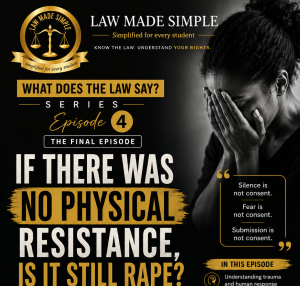 “If There Was No Physical Resistance, Is It Still Rape?”
 You’re just minding your business… maybe watching a movie, scrolling, or even about to sleep.