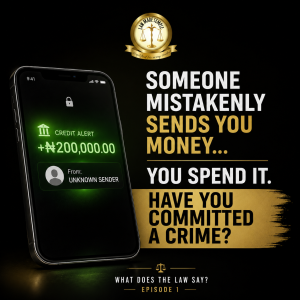
 You’re just minding your business… maybe watching a movie, scrolling, or even about to sleep.
Then bam your phone screen lights up a credit alert!
You check it the money is real. But the name? You don’t recognize it. You even try to take your thoughts back” but nobody asked for your account details now so how come?”
Nobody told you money was coming. It’s possible no one tells you the money was coming and they just send you a receipt but this time the name is unfamiliar.
So now the question is simple, Do you keep it or spend it?
It sounds like one of those lucky moments life just hands to you. But before you start planning how to use the money, pause for a second because the law actually has something to say about this situation, and it may not be what you expect.
So, what does the law say?
In Nigeria, receiving money by mistake is actually not the problem. The real issue begins the moment you decide to treat that money as if it belongs to you.
Legally, that money does not belong to you. It is what the law would consider a mistaken payment, and keeping it or spending it can bring you into trouble. This situation falls under principles similar to stealing or dishonest appropriation. Under criminal law, a person can be guilty of an offence if they dishonestly convert property that does not belong to them for their own use.
So even though you didn’t ask for the money, once you realize it is not yours and still decide to spend it, the law may interpret that as dishonesty.
“But I didn’t steal it… it was sent to me” that’s the tricky part.
You didn’t initiate the transfer, yes. But the law looks at what you do after you become aware of the mistake.
The moment you notice that first the sender is unknown,the payment was not intended for you, there is no legitimate reason for the money,You are expected to act in good faith.
Choosing to ignore that and spend the money can be seen as taking advantage of someone else’s mistake. Is it actually a crime? It can be.
Depending on the circumstances, spending mistakenly transferred money may amount to:
1.Stealing under criminal law
2.Obtaining property dishonestly
3.Even fraud in certain situations
Especially if you quickly withdraw or transfer the money, you ignore attempts by the sender or bank to recover it which is the height of intention to steal, you deliberately avoid being contacted.
At that point, it stops looking like an innocent mistake and starts looking intentional.
Now, what should you do instead?
This is where many people get it wrong. The safest and most legally sound steps are:
1.First, do not touch the money: I understand it can be very tempting but as tempting as it may be, leave it exactly as it is. Infact the money could when needs are pressing all around you just leave it as it is.
2.Next, notify your bank immediately: Banks deal with these situations often, and they can trace and reverse the transaction properly. If the sender contacts you, kindly cooperate. There is nothing to gain from being defensive when the truth is clear.
Why do people still spend it? A big question to ask.Honestly, because it feels harmless. Many people assume: “It’s the bank’s mistake”, “It’s free money”, “They won’t notice”
But in reality, these transactions are traceable. Banks keep detailed records, and once a complaint is made, investigations can begin. What seemed like “luck” can quickly turn into a legal issue.
The bigger picture is that situations like this show how close the law is to our everyday lives. It’s not always about big courtroom battles or high-profile cases. Sometimes, it’s about simple decisions we make in quiet moments.
Moments like: Do I take what isn’t mine… or do I do the right thing?
Finally, that unexpected credit alert might feel like a blessing but how you respond to it is what truly matters. In the eyes of the law,it’s not just about how the money came, it’s about what you chose to do with it.
This is the Law Made Simple — where we don’t just read the law, we understand it. See you next week!